The Oxford Handbook of Populism (Oxford Handbooks) by Cristóbal Rovira Kaltwasser Paul Taggart Paulina Ochoa Espejo and Pierre Ostiguy
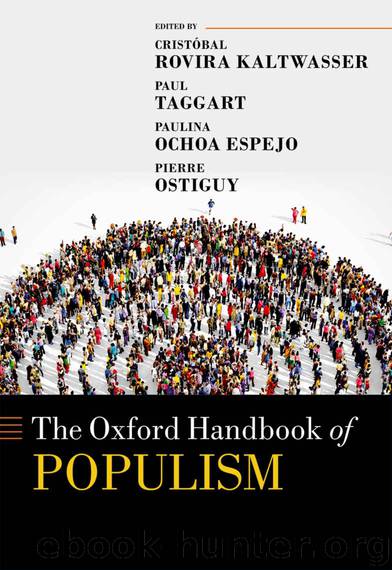
Author:Cristóbal Rovira Kaltwasser, Paul Taggart, Paulina Ochoa Espejo and Pierre Ostiguy
Language: eng
Format: azw3
Publisher: OUP Oxford
Published: 2017-10-25T16:00:00+00:00
TRANSNATIONAL POPULISM?
The prominence and strength of the articulations between nationalism and populism leads to the question of whether populism is necessarily nationalist, or at least national.6 Or to put it differently: is a transnational populism possible? So far, there has been very little true conceptual reflection on what could be called transnational populism (but see for example Gerbaudo, 2014; Pelfini, 2014). Theoretically, populism is certainly not necessarily national or nationalist. All that is needed to speak of transnational populism is a politics that discursively constructs and claims to represent a transnational people-as-underdog. However, whereas populism has frequently opposed a nationally defined people-as-underdog to supra-national and international elites, the construction of a transnational people-as-underdog has been far less common and straightforward.
There are two dimensions to transnational populism, the second more profoundly transnational than the first. A first dimension is the international cooperation between nationally organized populist parties and movements. Examples are the cooperation between left-wing populist leaders in Latin America (concretized for example in the foundation of the Bank of the South as an alternative to the World Bank and the International Monetary Fund), and the (difficult and partial) formation of political groups in the European Parliament by PRR parties. This is perhaps best labeled international rather than transnational populism: it is more about the inter-national ties between nationally organized populisms (that revolve around nationally defined people-as-underdogs) than about a truly trans-national politics across national contexts. A truly transnational populism is more profoundly transnational in that it constructs a transnational people-as-underdog as a political subject that supersedes the boundaries of the nation-state, rather than merely linking up national people-as-underdogs. In a reflection on “global populism,” Pelfini (2014: 199) speaks of the Occupy Movement and the indignados as “transnational connections of protests, cyberpolitics, and mass mobilizations, claiming for more democracy and against international financial agents” (see also Gerbaudo, 2014; Husted, 2015). The Occupy Movement’s claim to represent the “99 percent” against the “1 percent” does indeed have the potential to serve as a transnational populist claim to represent a transnational people-as-underdog (but this has largely remained a potential).
The distinction between international and transnational populism is a matter of degree: international populisms do create a transnational people-as-underdog, and transnational populisms bring together nationally organized political actors and nationally defined people-as-underdogs. Let me look at these two arguments in some more detail.
When populisms in different countries revolve around similar antagonisms between the people-as-underdog and the same international, transnational, and foreign elites (and similar national elites), the similarities and shared interests between nationally defined people-as-underdogs are accentuated and a transnational people is constructed to some extent. This is true even without actual cooperation between organizations, but is of course strengthened when nationally organized populists work together. The transnational people-as-underdog can have a socioeconomic basis, as when left-wing populisms oppose similar national economic and political elites and the same transnational (the IMF, the World Bank, the European Union, or even “neoliberalism”) and foreign (e.g. the US government) elites. The collaboration between left-wing Latin American populists is a case in point here.
Download
This site does not store any files on its server. We only index and link to content provided by other sites. Please contact the content providers to delete copyright contents if any and email us, we'll remove relevant links or contents immediately.
| Anarchism | Communism & Socialism |
| Conservatism & Liberalism | Democracy |
| Fascism | Libertarianism |
| Nationalism | Radicalism |
| Utopian |
The Secret History by Donna Tartt(19052)
The Social Justice Warrior Handbook by Lisa De Pasquale(12187)
Thirteen Reasons Why by Jay Asher(8893)
This Is How You Lose Her by Junot Diaz(6877)
Weapons of Math Destruction by Cathy O'Neil(6264)
Zero to One by Peter Thiel(5786)
Beartown by Fredrik Backman(5737)
The Myth of the Strong Leader by Archie Brown(5499)
The Fire Next Time by James Baldwin(5431)
How Democracies Die by Steven Levitsky & Daniel Ziblatt(5215)
Promise Me, Dad by Joe Biden(5141)
Stone's Rules by Roger Stone(5081)
A Higher Loyalty: Truth, Lies, and Leadership by James Comey(4954)
100 Deadly Skills by Clint Emerson(4921)
Rise and Kill First by Ronen Bergman(4779)
Secrecy World by Jake Bernstein(4741)
The David Icke Guide to the Global Conspiracy (and how to end it) by David Icke(4703)
The Farm by Tom Rob Smith(4502)
The Doomsday Machine by Daniel Ellsberg(4484)
